Meandering on the Way — July 20 to 27, 2025

Sunday, July 20th

Back when M was a child of twenty, he used to prepare for his backpacking adventures by baking cookies. They were hefty cookies–chocolate chip with butter, extra flour, lots of oats, and a little bit of wheat germ. He figured that if he took enough of these with him, along with some jerky and a few teabags, he would have a sufficiency of food. Nowadays when he goes camping with E, his diet includes others things–strange alien foods like carrots and lettuce and celery and oranges, plus the occasional masoor dahl chicken. However, there is still something to be said for cookies.

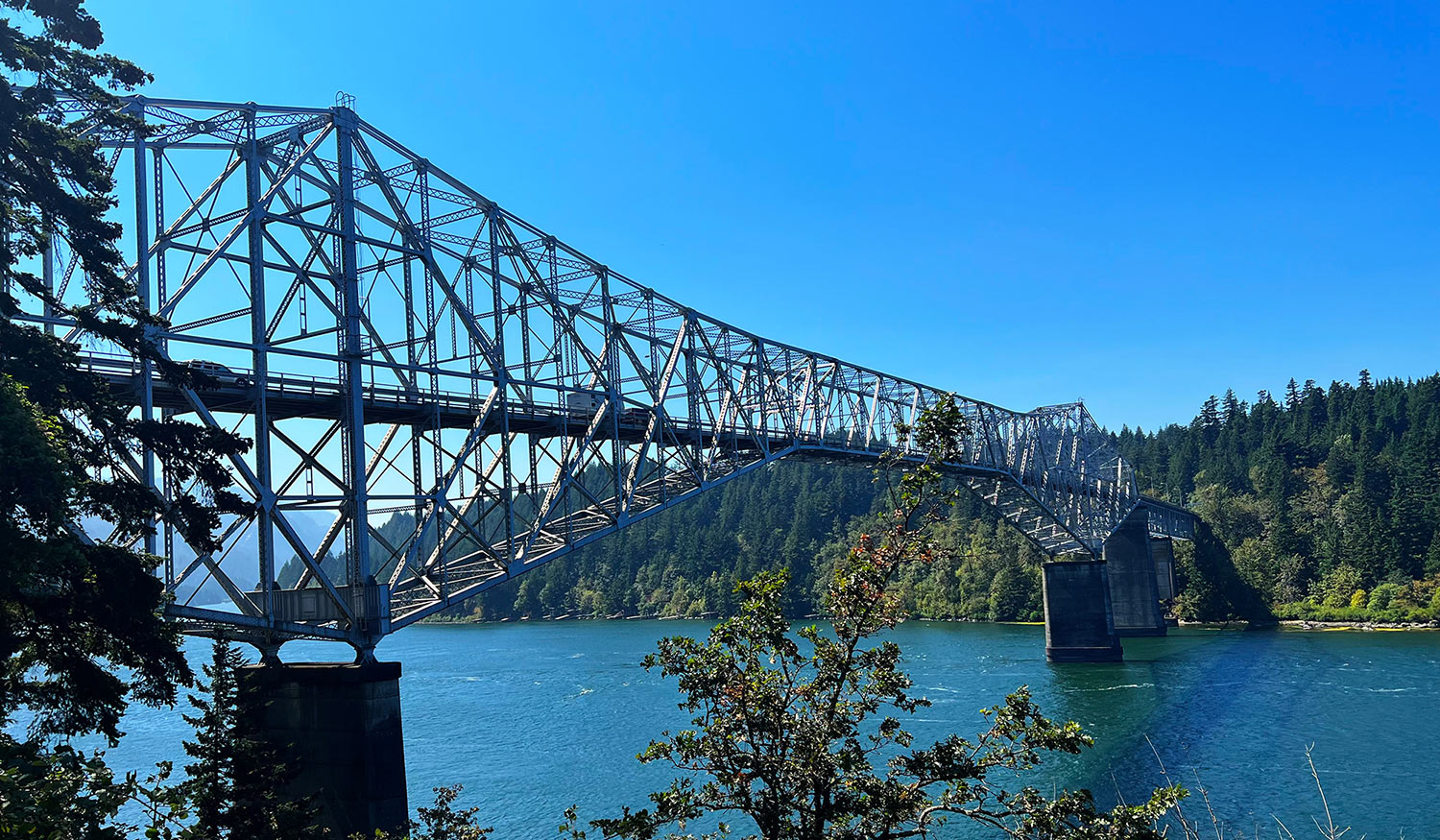
Having packed up our cookies and things, we left Corvallis at ten this morning. We drove north to Portland and then east up the Columbia River gorge. Thirty minutes from Troutdale we crossed the so-called Bridge of the Gods over to the Washington side. We gassed up in Stevenson, Washington. (Yes, we took a gas powered vehicle. Not many chargers available in the forest.)

The riverboat dock at the port of Stevenson. We ate our lunch at the dockside park.

At Carson, Washington we turned north, away from the river and up into the forests of the Washington Cascades. At around 2:00 in the afternoon, we stopped at a campground called Paradise Creek, where we were hoping to find an open spot. We knew that all the reservable spots would have long been taken. But we also knew that the campground had twelve first come first serve places (FCFS’s). We had planned our trip to get us there early enough in the day to maybe snag one. And it turned out that there were three open spots; we picked one and felt very much relieved.

The Paradise Creek campground turned out to be amazing. The campsites are all situated within a large stand of old growth trees: huge firs and cedars with trunks more than six feet across and crowns so high that it hurts your neck to see them.

When dinner time came, we realized that we had forgotten to bring certain key elements of our planned meal. So we had lettuce and mayonnaise sandwich made on pan fried hamburger buns. To accompany this, we chose to share a canned Cuervo margarita, nicely chilled. When it was time for dessert, we found that we had brought along quite a number of cookies. Later, E had her first experience sleeping in the back of the truck. It was very comfortable, she reports, but also claustrophobic.

Monday, July 21st

Our goal for Day 2 was to reach a place called Windy Ridge, where there were supposed to be some fine views of the Mt. St. Helens area. This wasn’t going to be easy, however, because we had found out just before we left Corvallis that the road we planned to take had been closed by a landslide. We had sketched out a detour, but it was long and complicated. You can see it on the right hand map below. The left hand map shows the route we had originally planned.

We started out at 8:30, making good time on a wide two lane road. Soon we came to a sign that told us to turn left to go to Windy Ridge. Sadly, another sign just beside it indicated that the route was actually closed, as we had suspected. At that point, the great detour adventure began. M drove while E kept track of our progress in our Benchmark Washington Road and Recreation Atlas. The views along the way started out nice and soon got even nicer. The roads, of course, got worse, becoming narrower and narrower and also turning to gravel. Fortunately, some of the critical road junctions had signage that helped us choose our turns. Also our atlas was excellent, so we never got lost. But there was no way to make the drive any shorter or the roads any smoother.

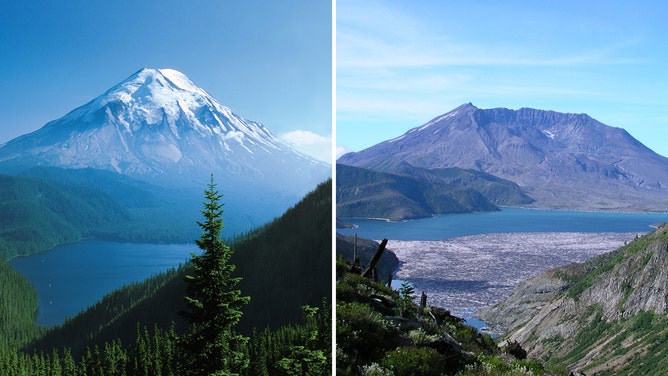
Finally, after about four hours, we got to a place where we knew we were heading straight for Windy Ridge and that we were probably not much more than an hour away. That was when we ran into road construction. Yup, road construction high in the mountains and deep in the forest. We stopped behind three other vehicles and noticed that the occupants were mostly out of their cars, either walking around or sitting in the middle of the road chewing the fat. We asked one fellow what was going on and found out we could expect a delay of at least twenty minutes. Great. On the other hand, it was 12:30; so we broke out our peanut butter and jelly sandwiches, Kettle chips, and little cans of juice and had a picnic on the shoulder of the road. After lunch we started the last leg of our journey. A half hour later we got our first glimpse of Mount St. Helens. Though the mountain was still many miles away, the slopes around us showed signs of the destruction that occurred forty-five years ago. The area is thick with trees, but the living trees are uniformly young. Only a few gray-white ghost trees remain from the 1980 forest. The ghosts are trees that were killed by the blast but not blown down.

Mount St. Helens is in the background, its peak hidden in the clouds. In the middle distance, where the blast wave was stronger, ghost trees are rare. At that distance everything was flattened.

Back in May of 1980, in the weeks before the eruption, it became clear that something big was about to happen. Authorities first ordered the evacuation of an area within four miles of the mountain. That was called the red zone and contained a popular recreation area that held lodges, campgrounds, and youth camps. In addition to the red zone, officials also established a blue zone. This was a larger circle that extended fifty miles in every direction from the mountain. Evacuation was ordered for the blue zone also, but this was considered by some to be a ridiculous excess of caution. As a kind of compromise, evacuees were allowed to re-enter the blue zone temporarily if they could show good cause. When the mountain erupted, the lodges and camps in the red zone were all empty and only two people died. Within the blue zone, fifty-four people were killed.

Just before the eruption, a couple who owned a mine in the blue zone got permission to enter. They took their nephew along with them. They drove up to Windy Ridge, parked beside the highway, and hiked eight miles up to the mine. When the mountain exploded, all three were killed. Back down by the road, the remains of their 1974 Pontiac Grand Prix have been preserved as a monument.
The mountain loomed larger as we got closer.
This is part of what they call the pumice plain. It lies at the foot of the northwest side of the mountain and covers the site of the old Spirit Lake, where the campgrounds and lodges were located. Since pumice is very low in plant nutrients, scientists did not expect even this level of natural recovery after only forty-five years.
The eruption knocked down millions of trees. When the new Spirit Lake was forming, hundreds of such trees ended up floating on its surface. The white patch that you see here is what remains of the great Spirit Lake log mat.

We took this photo as we were leaving. The clouds had lifted quite a bit and we could almost see the top. It’s still a big mountain, but it’s not what it was.

By the time we had viewed all we wanted to view it was 3:00 in the afternoon and we were tired. We had no time to rest though, as we had at least two more hours of driving before we reached our next planned stop: a motel in the town of Morton. Morton wasn’t all that far away, but for much of the route a person didn’t want to go more than 30 mph. Only on the last stretch could E put the pedal to the metal. We rolled into town at 5:00.

Tuesday, July 22nd

In the morning we drove Hwy 12 west to I-5 and took the sensible route home, making just one stop. At Bridgeport Village we had coffee and a sandwich at Peet’s and also dropped into REI. That was necessary because E had some patronage credit that she was itching to spend. She got some new sunglasses and a lightweight summer blouse. Also a new pair of hiking shorts for M. It was, after all, his birthday.

Wednesday, July 23rd

E had lunch with her THEPAJ group at Tarntip. When the family that owns Tarntip first came to town– lo, those many years ago–two sisters came to study with us at the English Language Institute. Today K took the time to come out from the kitchen and chat with the group. Very nice.

Friday, July 25th

Wonderful weather today, not too hot. This was good since we’d planned to go hiking. After getting back from that excursion, we had a quick dinner and then went to hear some live music. It was Celtic Festival weekend in Corvallis and the headline musical performance was by a group called Open the Door for Three. The three were a fiddler, an uilleann piper, and a bouzouki player/vocalist. They were very good. The concert was at PRAX, where we had never been, so that was also part of the fun.

Saturday, July 26th

In the morning we visited the Saturday Market to see another Celtic Festival event: a free performance by a marching bagpipe band. While we were there, we bought some blackberries. Later in the day, we drove the Road Shark up to Salem, where the Andees met us for dinner at the India Palace. M got another b-day present, a jigsaw version of a portrait of Gertrudis Gomez de Avellaneda by Federico Madrazo. It was a lovely second birthday dinner. M also also enjoyed the drive to and from Salem. He is still learning about the little Beamer, so on the way home, when it started to get dark, he had to pull over and spend some time figuring out how to turn the lights on.

Sunday, July 27th

Two words: blackberry pie.

Meandering on the Way — July 12 to 19, 2025

Friday, July 11th

We went down to Eugene today. E wanted to visit the Lululemon store there. Strangely enough, the shop is just across the street from the Euphoria Chocolate shop, which is just two doors away from a very nice Thai restaurant. What a serendipitous non-coincidence! On our way back to Corvallis, we stopped at Peoria Gardens, a big wholesale nursery. E had just found out that for two weeks a year Peoria Gardens opens to the public and that this was one of those weeks. We wanted to check it out.

Hot weather seems to have settled in pretty good around here, so maybe this is not the best time to be adding new plants. But the prices! We ended up getting three plants for just $21. Now, do we have the strength to get them into the ground?

Saturday, July 12th

Well… E struck first, getting her new sunflower planted early this morning. Two more to go.

Later in the morning, we went to an event put on by the Letitia Carson Legacy Project out on Tampico Road, just north of Corvallis. The LCLP is jointly sponsored by Oregon Black Pioneers, Oregon State University, Black Oregon Land Trust, and Linn-Benton NAACP. Carson was a farmer and homesteader who first came to the Corvallis area in 1849 and hers is quite a story. She was born into slavery in Kentucky around 1816. By September of 1844 she was living in Missouri with a man named David Carson, a naturalized Irish immigrant and the father of her unborn child. In the Spring of 1845 the two joined a large group of immigrants on a journey from Missouri to Oregon. Their daughter Martha was born in June of 1945 as they were crossing Nebraska. In late 1845 they reached Oregon and David filed a homestead claim for 640 acres in Benton County just north of Corvallis. They built a house on the land in the spring of 1846.

The Carson land claim is now a part of Oregon State University and is managed by the Department of Animal and Rangeland Science. One way in which the University supports the LCLP is by giving permission to hold outreach events in an area that is normally closed to the public. When we arrived, the pasture gate was open and cars were parked on the grass. We met our hosts and the other tour members under a canopy, signed our waivers, and set off for a two-mile walk. Our guide led us out of the pasture and into a riparian area of large trees and thick understory on the banks of Soap Creek. The project had recently created a path through this area leading to the site of the Carson residence. The path begins at a place where some young trees have formed a kind of archway.

Our guide, seen here in the center, called this the Fairy Portal. We liked her right away.

On its way to the homesite, the trail passes a number of large fruit trees which have been long untended. The oldest of these is this huge pear three that is estimated to be around 200 years old. It is possible that the Carsons walked past this tree when it was a youngster.

There were a number of other large apple and cherry trees in the area, all growing wild. They are not nearly as old as the pear, but they are almost certainly descended from trees planted by early settlers. At the same time, the area hosts an array of native plants including large oak, maple and ash trees, as well as many types of understory plants, some of which are also growing in our back yard. Unlike our yard, however, this small area is real wild land, settled 175 years ago but neglected for the last hundred or so.

Nothing remains of the Carson House; but the trail does take you to the spot where the house probably stood, right where E is walking in the photo below. Just behind the main mass of foliage in the picture, there is a year round stream, which would have been their water source.

None of the current trees are old enough to have been present back when the house was here, but they are likely the descendants of trees that were there.

The meadowland portion of the Carson claim was located immediately to the east of the homesite, so they would have been able to keep an eye on their stock. Nowadays–one hundred and seventy-five years later–there are still cows pastured where theirs were, as the area is part of the range of OSU’s Cattle Research Herd.

The Carson homestead seems to have thrived for a time and in September of 1849, they had another child, this time a son. In 1852, however, David Carson fell ill and died. Letitia’s status at this point was unclear. As Zachary Stocks puts in his Oregon Encyclopedia article, “While Letitia was likely Carson’s slave at some point, she would later claim to have been his free domestic servant and identified as his widow after his death.”

Upon David’s death, Benton County authorities determined that Letitia had no right of inheritance or any other claim to the property, which left her and her two children homeless. The land and goods were auctioned off and the proceeds were distributed to David Carson’s relatives in North Carolina. But that was far from the end of the story. First, we know that Letitia attended the auction and paid $104.87 to buy back what she could of her own possessions: a washtub, a pot, a skillet and lid, six plates, a bed and bedding, two cows, and a calf. Next, she joined another group of settlers headed for another land claim area, this time in Douglas County, 160 miles to the south.

In 1854, while living in Douglas County, she engaged a Corvallis lawyer and filed a lawsuit seeking damages for her losses in Benton County. The suit went to trial and ended with a hung jury. The case was then retried. In the second trial twelve white male jurors unanimously found in her favor and awarded her damages. There was then a third trial concerning the separate matter of who owned the Carson’s herd of 34 cattle. During this trial a neighbor testified that David Carson himself, in the year before his death, had stated that “only seven of cattle were his and the rest belonged to Letitia.” All told, Letitia Carson was awarded $1500 plus $230 in court costs.

In 1863 Carson filed her own homestead claim on a 160 acre tract near her new home in Douglas County. In 1869, after making the required improvements, she applied for and received certification of her claim. She is the only known black woman to have accomplished this in Oregon. Her story was the inspiration for Jane Kirkpatrick’s 2014 novel A Light In The Wilderness. Carson died in 1888, leaving her land to her son. Her daughter, Martha, married a French-Walla Walla man named Narcisse Lavadour with whom she had seven children.

Sunday, July 13th

This time it is M who gets up early and puts his hebe plant into the ground.

Monday, July 14th

And finally E and M join forces to plant the last of their purchases, a Russian sage. M digs the hole and E plunks in the plant.

Wednesday, July 16th

Having completed the purchase of the frivolous toy car, we must now move on to the serious real car. The lease on our Ioniq 5 expires next month. It has been a wonderful car and our lease agreement has a buy-out option. So we could just keep it. But the buy-out price specified in the lease agreement is higher than the price of several identical 2023 Ioniq 5‘s that we currently see advertised in the used car market–about $10,000 higher. We love the car, but don’t love it that much. So we need to make a change. What shall we do? Go back to a gasoline or gasoline/hybrid car? Not a tinker’s chance. Lease a new Ioniq? Buy one? Maybe.

So today we went car shopping, starting out early in the morning because the forecast was for a highs in the mid nineties. We got to Beaverton around ten and went to check out a Kia EV-6. Nice. Very nice. Then we headed back south to Salem to check out what the newest Ioniq 5 is like. On the way we stopped at a rest area and had our lunch– dry roasted peanuts, generous portions of nicely chilled gazpacho, and two pieces of chocolate. This got us ready for the next dealership.

Which was Withnell’s in Salem, where we looked at the newest Ioniq-5’s. They’re nice too, both the dealership and the car. The only great flaw in the 2023 model was the lack of a wiper for the rear window. For 2025, that lack has been remedied. So now we have a lot to think about. Both the EV6 and the Ioniq 5 are made in the U.S. and thus currently qualify for the $7,500 tax credit, so that’s a wash.

Thursday, July 17th

We had a number of responses to the question of whether or not to keep the BMW’s RDSHARK license plates. All were in favor. And that’s how it’s going to be.

This is a 25 year old car and has 92,000 miles on it, but looks awfully good under the hood. The previous owner did a lot of work. All the hoses are new and all the old brake lines have been replaced by new steel ones. The radiator and radiator fan, which are known weak points on these cars, have been replaced with better than original parts. Also note the lovely reinforcing bar running across the top of the engine between the strut towers. The bar is original but must have had its surface refinished at some point. The engine is a straight six (not a V6) and was originally designed for larger BMW models. It is too tall fit under the hood of this car, so it has been mounted slightly at a slant.
The color plaque is on the driver’s side strut tower. The car was made at the BMW factory in Spartanburg, South Carolina, but this bit is very German. The color is Imola Red, Imola being a legendary Italian racetrack.
The seats have also been refurbished recently. The interior fits two people comfortably, but they can’t bring very much with them as there is just about zero extra space. The car has a five speed manual transmission and goes like stink.
But there is some space in the trunk. Right now part of it is taken up by a folded set of BMW brand luggage designed especially to fit the shape of this trunk. There are also three storage pouches on the underside of the trunk lid.
Inside the trunk, on the right side, the previous owner installed this extra piece that he most likely made himself. It provides a bracket to hold a fire extinguisher–just in case you get into a road rage incident involving molotov cocktails–and also gives him a place to mount some extra sharkiness.

Friday, July 18th

We called the Kia dealer in Beaverton and asked about our chances o get a blue EV6. Our salesperson said he’d check and get back to us. What he found was that there were no blue ones available for dealer swap anywhere in the Northwest. But…he said that his very dealership has a blue one on order. It is expected to arrive in the first week of September. Hm. That wouldn’t be too bad. The new car would arrive two weeks after we turn in our old one, but we maybe we could deal with that. E could cruise around in the truck, leaving M stuck with the Shark. Or vice versa. (In the immortal words of La Botanica, “Step on it, Ev!”)

Saturday, July 19th

But enough about cars. Tomorrow we’re going camping. It’s taking us a while to get ready. Must focus!

Meandering on the Way — June 27 to July 8, 2025

Friday, June 27th

We went up to Portland today and shopped at the Columbia Sportswear Employee store. Our friend J had given E a one-time pass to go in and buy stuff for the same price that Columbia employees pay. E got a fleece jacket and some pants that she needed while M got a jacket and a pair of hiking pants that he sorta, maybe needed.

All prices in the store are 40% or 50% off. Off of what exactly? That’s hard to say. They have a great selection though, and we had a good time.

We also had fun at our next stop: Kitchen Kaboodle, a venerable kitchen/home store that we hadn’t visited in years. We got some new cotton napkins and E got herself an apron. On our way home we stopped at our favorite shoe store at Bridgeport Village. No luck there, but we were tired. Three things in one day are probably too much for us old folks.

Wednesday, July 2nd

M’s Jaguar F-Type has been gone for a couple weeks now, having been sold down the river to Carmax. It was a wonderful car–fast, luxurious, and reliable. We both loved it. So why is it gone? Mostly because this seems to be M’s pattern. (E comments that she’s glad M doesn’t change wives as often as he changes cars.) In this case, one of his rationales was that the Jag didn’t really fit in the garage and had to be stored offsite at considerable expense. Also, its very expensive tires were not getting any younger. And, its very expensive brakes were giving an occasional hint of a warped rotor somewhere.

So what’s next? We don’t know. Could M survive without a sports car for a while, maybe a long while? And what about E? If M didn’t have a nice car, would she have to dump him and look for a partner who could provide for her properly? That would be awkward.

So today, in an attempt to deal with the situation, M went up to Portland to look at Mazda Miatas. He’d had one before and liked it. In fact that was the car that he had when E married him. But what he found today was that the time for a Miata has passed. Yes, a Miata would fit into the garage. And no, a Miata is not too hard to get into and out of, even at our age. But the ride quality is for younger people. Plus it has almost no power at all. M sees no clear way forward.

Thursday, July 3rd

Tertulia at Coffee People with J, after which we went home and attacked the garden. The garden is having a visitor tomorrow and we’ve been trying to make it look presentable. Nice weather for gardening: sunny but cool with 60’s in the morning, 70’s in the afternoon.

Friday, July 4th

E’s friend B came over in the morning and had her garden tour. She came bearing gifts: two Aucoba japonica starts. These will join the ones we have in the shady back corner.

B is not in the picture, but her gifts (in the white bucket) have already arrived.
A real melange here, with native thimbleberry, salal, switchgrass, cascara and two kinds of mahonia sharing space with alien black mondo and Mexican orange.
The Mahonia is fruiting nicely. Those ‘Oregon grapes’ are tart but mostly safe to eat in small quantities. Not recommended for pregnant or nursing mothers.
Our best hydrangea year ever–which isn’t saying too much.
From left to right: crocosmia, raspberries, an almost invisible lilac, and clematis growing on ninebark.
Shasta daisies.

Saturday, July 5th

Got the Aucobas into the ground.

Sunday, July 6th

Well! Oddly enough, the guy down the street has parked his little sports car out on his front lawn. It’s for sale.

The weather has turned hot. We only work in the garden early in the morning.

Monday, July 7th

Chores and shopping. We notice that the little car is gone from the owner’s front lawn. Sold already?

Tuesday, July 8th

Jam making day! E headed out to the Peoria farm market to get a flat of raspberries. On her way she noticed that the little car is back and is still for sale. She stopped at Bi-Mart and texted M to go check it out. When she got back, M said it was time for her to look at it too.

After that, E got on to the important work of making a couple of batches of jam–a total of fourteen and a half jars.

Meanwhile M occupied his time by poking around the Internet boning up on older BMW M cars and processing the lengthy history and features of this one:

Eventually he bought it because, you know, it fits in the garage. Also, the price was right.

The burning question now is whether to keep the previous owner’s custom license plates or replace them with something a little more subdued. Does anyone have any advice?

Crossing Central Washington — Washtucna to Napavine

Palouse Falls — Drumheller Scablands — Othello — Hanford Reach — White Pass

(This posting is part of the Road Trip series. Meandering on the Way will return soon.)

There’s a nice freeway that runs east/west through the state of Washington. If you were traveling west, you could start in Spokane, a town of 230,000 near the Idaho border, and pretty quickly end up in the Seattle area, where 3,581,000 people live near the shores of Puget Sound. That would be fine. But there are lots of other ways to cross the state. You could, for example, start in a Washington town called Pasco. That’s where M started in June of 2025.

In Pasco, M stayed at a Hampton Inn that was in the midst of transitioning into something else. He dined at a Mexican restaurant called Trejo’s, which was really good. In the morning he found Washington Hwy 124 and left Pasco heading east. Soon he found himself on a bridge crossing over the Snake River, just a mile north of where it flows into the Columbia. Oregonians tend to think of the Columbia as that big old thing that runs west across the top of the state until it finally reaches the Pacific Ocean. But at the place where the Snake flows into the Columbia, the Columbia is actually flowing southeast, which was something that M had not expected. However, as he himself was beginning his westward journey across Washington by heading east, he could hardly object if the Columbia was doing something similar. (More on that later.)

Since his first destination was Palouse Falls, he eventually turned off of 124 and took a small road northeast toward Clyde and Lyons Ferry. The route led him out the farming country he’d been seeing and into something…different.

The road to Lyons Ferry

When M got to Lyons Ferry he found that it doesn’t have a ferry anymore. But it is still the spot where the Palouse River flows into the Snake River. And it is quite a place, in its way. For one thing, there is a rather striking railroad bridge over the Snake just downstream from where the Palouse comes in.

The Snake is curving around on the left and the Palouse is entering from the right. The birds are just sitting there.

There’s also a highway bridge. At its north end there’s a nice state park down among the trees.

M crossed the highway bridge and found that the main road made a hard left. It then took him under the railroad bridge, which at that point looked like this:

From Lyons Ferry–the place of the two bridges–it’s just a few more miles to Palouse Falls State Park. To use the park, you have to display a Discover Washington recreation pass. Fortunately, M had bought such a pass. Less fortunately, he had forgotten to bring it. So he parked in the main lot anyway and hoped for the best. The place was mostly empty. Here’s his first glimpse of the falls.

And here’s the big picture:

Remember that railroad bridge at Lyons Ferry? That same rail line passes very near to Palouse Falls. M took the following photo from a little bridge where the Palouse State Park road crosses over the track. The falls are just a few hundred yards away.

Click the link to see drone footage of a Canadian Pacific train coming down from the north through this exact spot.

Now that he’d seen the waterfall, it was time for M to get serious about his goal of traveling west. Naturally, his first step was to drive northeast. Sigh. But not for long. At a town called Washtucna (population 211, said to have been named for a prominent Palouse Native American) he turned left onto Hwy 126 and headed west. It was at about this time that the day started getting warmer, which was unfortunate because the air conditioning on M’s truck wasn’t working. The fan roared, but the air coming out of the vents was awfully warm. Great.

At this point M was aiming to get to the town of Othello, where he figured he could turn north and make a visit to a place called Drumheller Channels. It was only about 45 miles to Othello, but the temperature was up to 88. M drove with both windows slightly open to get some air circulation and to ameliorate the greenhouse effect. It was hot and noisy. He thought of the old days, a trip he’d taken with his family from Utah to Colorado in the early sixties. That had been a hot ride also–back in the days when cars didn’t have air conditioning. As far as M is concerned, we–as a society–should probably not go back to those days, at least not till things go truly bad.

From Othello it was just fifteen minutes to the Drumheller Channels National Natural Landmark. M had never before experienced anything called a National Natural Landmark. What was that supposed to be exactly? Well, here’s what it looked like from the viewpoint:

Hmm. M was not impressed. This landmark, whatever it was, just looked hot, dry and seriously lacking in shade. But, as it happens, there are some landmarks that you can only really see if you use your imagination. (And yes, that does mean that M had driven fifty miles through the heat just so he could visit an imaginary landmark, but bear with us.) The interesting thing about this landscape is the matter of how it came to exist–the past events that caused it to be what we see today.

There are in fact lots of places in Washington that are similar to this. The first person to study them and provide an explanation of how they were formed was an Univ. of Washington geologist named J Harlen Bretz. In the summer of 1922, Bretz became fascinated by the geology of the eastern part of the state. He saw that the landscape included what appeared to be very large potholes, ripples and water channels. These are the same features that are found today in rivers everywhere. The only difference was that the ones he was seeing in the landscape were up to a hundred times larger. He concluded that these channeled scablands–as they are now called–must have been created by one or more massive floods in the distant past. During the next few years Bretz published a series of papers on the topic, all of which were unanimously rejected by the Geology establishment, which was then dominated by Ivy League Geology departments.

Bretz stuck to his guns and forty years of academic debate ensued. During those years another geologist, Joseph Pardee, began publishing his findings concerning Glacial Lake Missoula. Pardee’s work provided more evidence in support of Bretz’s theories, as did analysis of satellite photos and other research in the 1970’s. In 1979, when Bretz was 96, he was awarded the Penrose Medal, the Geological Society of America’s highest honor. “All my enemies are dead,” he told his son, “so I have no one to gloat over.”

So…to properly appreciate the view at the Drumheller Channels National Natural Landmark, all you have to do is imagine that that there is a river flowing over this scene from left to right–a really big river, a river 500 feet deep and who knows how many miles wide. Let’s try looking at the photo again and this time adding in the river.

Of course if the river was 600 feet deep, we’d be standing here under 350 feet under water. So, to avoid our imaginary drowning, maybe we should move along.

When M left the Drumheller Scablands viewpoint, it was getting to be lunchtime. He had prepared himself a lunch before leaving Pasco. Now what he needed was some shady place where he could sit down and eat it. His best bet was to find a park in Othello (pop. 8,549). He ended up in Pioneer Park, which may not be the most pleasant park ever made. It is on the main highway through town and just half a block from another busy route. But…it had a picnic table in the shade and a lovely view of this USAF T-33 training aircraft. The T-33 was developed in the 1951 for the express purpose of teaching experienced propeller plane pilots how to fly jets.

Othello’s connection to the U.S. Air Force dates back to the cold war era. From 1951 to 1973, the 637th Radar Squadron was stationed just outside of town.

If you ever find yourself in downtown Othello, take a drive up North Broadway Avenue to the north end of town. That will take about a minute and a half. There you will see a half dozen or so large industrial buildings, some of which look like factories. M saw them as he drove through and wondered what they were making. Turns out it that pretty much everything in Othello is about potatoes. The industrial buildings are all either cold storage facilities or factories that make frozen potatoes. The complex in the north end of Othello is owned by a company called McCain. Another similar complex a few miles east of town is owned by Simplot. The production of these two facilities combined means that Othello processors account for 1.5 billion pounds of frozen potatoes annually, roughly 15% of all North American production. By coincidence, the small bag of Kettle chips that M had with his Pioneer Park lunch weighed exactly 1.5 ounces. They were delicious.

The day was advancing and M wasn’t even halfway across the state. It was time to get a move on. M got back in the truck and drove down South Broadway Ave till he could turn west onto Washington Hwy 24. This would take him across the top of a large arid plain called the Hanford Reach and then along to the city of Yakima. The Hanford Reach, as M saw it while driving across its northernmost section, looked like this.

At this point M was following Hwy 24 straight west through a portion of what is now the Hanford Reach National Monument. The Monument was created in 2000 and includes 325 square miles of land. Those 325 square miles had previously been part of a security buffer zone within the Hanford Nuclear Site. On the map below the jagged blue and gray line shows the extent of the original Hanford Nuclear Site. The gray areas are the land that was removed from the nuclear site in 2000 and turned into a National Monument. The white area in the center is the core of the original nuclear site and is now called the Dept. of Energy Hanford Reservation. It covers 586 square miles. The thick black line that runs from the upper left to lower right is the Columbia River. M’s route is shown in green.

You can see on the map that M crossed the Columbia River just a few miles west of a small gray square labelled B/C. M remembers crossing the river and noticing two things. First, how odd it was to again see the river flowing eastward and second, that it was a much smaller Columbia River than he was used to seeing. What he didn’t quite realize at that moment was how near he was to the site of the Hanford B and C nuclear reactors. Completed in 1944, Hanford B was the world’s first large scale plutonium production reactor. Hanford B produced plutonium for the world’s first atomic bomb–the test device that was detonated in New Mexico on July 16, 1945–and also for the bomb dropped on Nagasaki on August 9, 1945.

In the following years, seven more reactors were built on the south bank of the Columbia. All of them used river water for cooling. As the water passed through the reactors it became contaminated with radioactive isotopes of many elements and also with a number of toxic cleaning chemicals. When it left the reactor the water was directed into one of the more than one hundred “retention basins” where it was allowed to cool down from its 200 degree temperature. Retention time was “up to” six hours. Then, still quite warm, it was pumped back into the river. (See this article for details about the effects of this practice.) The Hanford reactor bank continued to produce weapons grade plutonium for the next 27 years..

Once past Hanford, Hwy 24 took M westward toward Yakima. He got there in mid afternoon and stopped only to get gas before taking Hwy 12 northwest into the foothills of the Cascades. Slowly but surely, as he climbed into the mountains, the temperature declined. Good. Before too long he reached the summit at White Pass and began descending down the west side of the mountains. The road was good but had only two lanes and was very curvy. The scenery made a nice change from that of the central and eastern parts of the state.

Shortly after he stopped to see the waterfall, as M was continuing down the mountain, going reasonably fast, he suddenly noticed a white car right behind him, very close behind him. It was some kind of exotic sports car, possibly a Lamborghini; he couldn’t really tell. Clearly the driver would like to pass. Just as clearly, what with all the constant curves, passing would not be safe. While M was stewing about this, another car came up close behind the white one. It was also an exotic, a Ferrari. Behind that appeared a red Porsche, and behind that several more vehicles of the same sort. M couldn’t see how many because of the curves in the road. He thought it must be some high end car club out on a run. They were probably based in Seattle and planned to loop back up that way when they were done with Hwy 12. M did not like being in the front of this particular group. It had been a long day and this was not something he had planned on dealing with.

After a few minutes and a few more curves, M realized that the experience was a little like driving the pace car at the beginning of the Indianapolis 500. The idea there is for the pace car to drive one lap of the raceway at a very moderate speed with all the real racing cars tucked in obediently behind. At the end of that one lap, the pace car darts quickly out of the way, the race drivers all hit the gas and the event begins. On this road, though, there was no place for M to pull over and get out of the way. But wait, maybe there was. What about that place? It was on the wrong side of the road but never mind. M turned on his left turn signal, hit the gas and quickly crossed over to the wide spot, braking hard as he arrived. He was rewarded with an almost immediate roar of sound as the line of sportsters all got back on the throttle. The white Lambo shot ahead and disappeared in the blink of an eye around the next curve, followed by all the other cars in the line. It turns out there were ten or more cars in the group. One driver, seventh or eighth in line, gave M a casual wave as they passed. Then it was all quiet again.

Eventually M got down out of the mountains and found the town of Morton, where he checked into a motel. The next morning he continued on through the towns of Mossyrock, Saltum and Ethel. A little after 10:00 AM, he reached Interstate 5 near the town of Napavine (pop. 1,988). He didn’t quite reach the shores of the Pacific, bur he’d gone far enough. He turned south toward Oregon and home.

Wait a minute, is that the same Napavine that hosts the annual Napavine Funtime Festival? Why yes it is. Thanks for asking. And did they used to have a parade starring a teenage beauty who had been chosen as that year’s “Princess Napawinah” in honor of the 18th-century Newaukum tribal leader for whom the town was named? Well…yeah, more or less. Was the princess usually a white girl? Uh..we dunno. But was she dressed in elaborate “pan-Indian” regalia of a kind never worn by any real Native American woman anywhere? By all reports, that is correct. Is there any good evidence that there ever was a real woman named Napawyna for whom the town could be named? Actually, no. Might the town’s name come instead from the Newaukum word “napavoon” meaning “small prairie?” Possibly. And does the town still honor Princess Napawinah during their Funtime Festival? Since 2023, no. And finally, are some longtime Napavine residents still really upset about that transition? Almost certainly.