Dinner with old friends R (a.k.a. K) and L. It was great to catch up with what they’ve been doing. For one thing they have recently been to Scotland and Ireland. They report seeing some lovely places and finding that the people are very nice. They also confirmed something that we have heard from other friends, the fact that in Ireland, it is indeed possible to have a meal that includes three different potato dishes.
Tuesday, October 6th
E got some shots today, covid and flu, one in each arm. Brave woman.
Wednesday, October 7th
In the morning, E felt great. In the afternoon…pretty terrible. She now vows never to have both shots in the same day.
Friday, October 9th
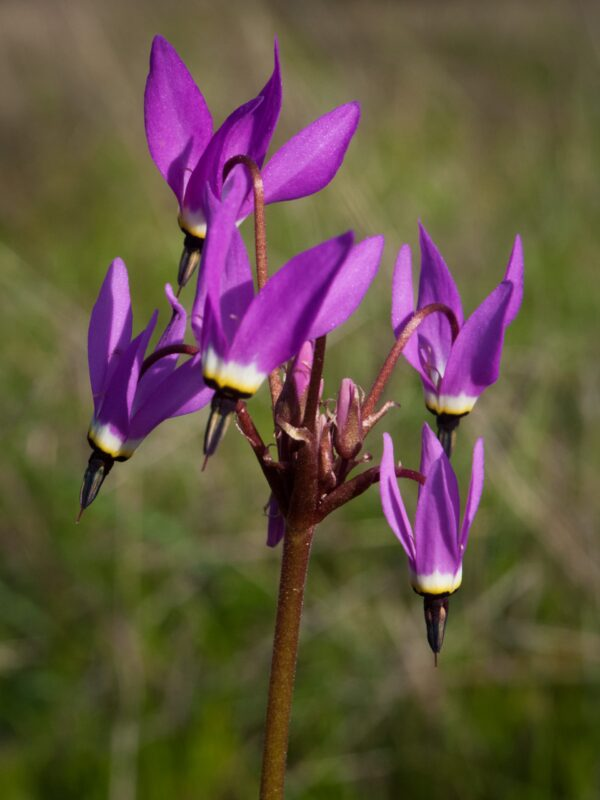
We drove north today, up to Dallas, OR to pick up some plants that M had ordered from the Polk Soil and Water District’s fall plant sale. It was a crisp sunny day that made for a beautiful drive through the country. The fall colors in the trees along the creeks made a nice contrast with the bright new green of the winter seed fields where the shoots are beginning to pop up from the ground. We got five plants from the sale: four Broad-leaved Shooting Star and one Salal (Gaultheira shallon).
Saturday, October 12th
A busy day. While M was getting his plants in the ground, E rode her bike to The Shuck, an annual gathering held at Avery Park. She met A there and had a chance to meet up with people that she doesn’t often see.
In the late afternoon, A went with us to the forest to spread a few ashes in honor of John Chambers, brother to E and uncle to A. Poems were read and wee drams taken. The poem that A read was Epitaph on My Own Friend by Robert Burns.
Sunday, October 11th
It’s been a couple of weeks now since we suffered the traumatic closing of the French pastry shop where we used to get croissants for our Sunday breakfast. To cope with a second straight week of going without, we baked up some Rhodes rolls and slathered them with butter and jam. No match for Le Patissier’s croissants, but surprisingly not bad.
The weather has been fine, mostly bright days and cold nights. It was 35 degrees when we woke up one morning. The back yard is looking fallish.
Monday, October 12th
Coffee with M’s honorary sister M today to discuss (1) our upcoming trip to Mexico City, which sister M knows quite well, and (2) sister M’s plans for getting a new electric vehicle. In regard to the first point, she told us about an extremely important place that we must not neglect to visit. More on that, hopefully, in a future posting. In regard to the second, honorary brother M presented her with a newly discovered EV option: the Subaru Trailseeker.
In Other October News:
M has finished writing a book called Hither and Yon, The Autobiography of M.
It begins with his childhood and adolescence in Utah and continues on to the various and sundry places where he later lived and worked. The volume ends in 2008 as M and E return to Corvallis after their year of working in Turkey.
The book was printed and published by Amazon and is for sale on the Amazon website. Meandering subscribers, however, can get a free copy direct from the author. If you are interested, please contact E, who has recently accepted the position of Order Fulfillment Manager.
Here’s what our house looked like in 2017 when we moved in. We didn’t think much of the color. The paint was in good condition though, so we couldn’t justify redoing it.
We soon changed the trim color to white, which helped a little. By the summer of 2026, the whole house was faded and starting to peel.
We called upon Equilibrium Painters for assistance. Prep work started today; color goes on tomorrow.
Thursday, September 17th
We went down to Eugene today and had lunch with our friend S. Just last week, she had her house painted. We commiserated with her about what it’s like to have all your windows covered with plastic.
Friday, September 18th
The painters have been busy. The base color is done already. Trim and accent colors will have to wait for next week. Luckily, the weather forecast is good.
Monday, September 21st
We learned today that E’s cousin Ross has passed away. It’s a sad moment, but given his condition, it comes as a release. E is glad to have had a visit with him last month.
Tuesday, September 22nd
We went back to Eugene today, this time to take our EV6 in for some recall fixes. The Kia dealership is one of six car dealers located out near Valley River Center. While they worked on the car, we walked up Goodpasture Island Road a few hundred yards and went walking in Delta Ponds Park. It was a pleasant surprise to find a lovely piece of nature hidden away so close to a highway and a shopping center.
As for the car, the technicians were only able to finish part of the needed upgrades. They had to order a part for the fourth one. Sigh. There was also a strange vibe among the service reps, an undercurrent of hostility as if they were in the midst of some bitter internecine struggle, one that required all their energies and left little time for such mundane matters as actually helping people with their cars . We’ve dealt with three different Kia dealerships now; none have impressed.
But the big news of the day was that we got back home just in time to celebrate the completion of the painting project! We’re happy now.
Wednesday, September 23rd
We went down to the OSU campus for a walking tour given by Dan Blanchard, the curator of the OSU Campus Arboretum. The 435-acre central campus is home to over 65,000 individual trees and shrubs. Dan didn’t show us all of them, but we did see plenty. Some were familiar, like the trees that form the lower campus Elm Walk, which dates from 1906.
But he also showed us dozens of lesser known plants, that have been brought to OSU from around the U.S. There were 14 of us on the tour and several sharp participants could identify many of them without Dan’s help. Here’s one that was a little tricky:
What kind of tree is this? For sure E and M didn’t know. It looked like an olive.
Kudos to anyone who recognizes it as a Silverleaf Oak, Quercushypoleucoides, native to the Southwestern United States and Mexico. And yes, it does produce acorns, although we did not see any on this day.
Friday, September 25th
E went with her friend H to the Methodist church basement to see a Best Cellar Coffee House performance by Sharon and Dave Thormahlen, a harp and guitar duo. Besides going clubbing in the evening, E has been walking in the forest most days.
Here she finds an old tree that has seen better days.
And here are some sword ferns that look to have been wakened from their late summer stupor by yesterday’s rain.
Today we went to the Snag Boat Bend Unit of Finley Refuge. The area had been closed for a few months because of work to reopen an old side channel of the Willamette River. The work involved cutting a wide notch in an earthen dike that was built many years ago by the U.S. Army Corps of Engineers. The aim is to restore fish habitat in the area near Lake Creek. Along the way we took in the sights.
Here’s how the channel looked on this day. We look forward to checking it out when the river level rises.
And here’s a sweat bee, Halictus ligatus, perched on a chicory flower.
Thursday, September 10th
Lots of news reports from Yemen today. The Houthis have defeated government forces and captured the port city of Mocha. This allows them to have greater control of the Strait of Mandeb at the southern end of the Red Sea. This is significant because all ships that use the Suez Canal must also pass through the Bab al-Mandeb. In theory, then, Houthi control of Mocha gives them the ability to effectively shut down the Canal.
M passed through Mocha a several times while he was living in Sana’a, Yemen in the late 1980’s. The country was peaceful in those years and Mocha seemed like a sleepy sort of place. M took this photo in 1988 on a beach at the north end of town:
Mocha has grown and become more important in recent years. Here’s another seaside photo, this one from just yesterday:
Saturday, September 12th
We went to see a play today, a production of Come From Away done by the Albany Civic Theater. (Albany, OR, that is.) It was tremendous! Who knew there was such talent in Albany? Well…I guess our friend J knew. Big thanks to her for suggesting this. We had dinner with J, B, and M before the play. The new Sybaris restaurant is pretty great also.
Sunday, September 13th
We went off to do some camping again today. The nice part was that we were going to Yukwah campground in the Cascades, which is only about an hour away. The bad part was that it was raining as we left. We considered this at some length. The forecast, however, was for the rain to stop, more or less by the time we would get there. So off we went. And sure enough, when we arrived, the rain was petering out. Things were pretty damp though, and we heard a constant pattering as water dripped off the needles of the fir trees high above and splatted down onto the leaves of the understory.
Yukwah is a very old campground, close to the highway but located within a small segment of natural old growth forest beside the South Santiam River. Such places have magic and as we busied ourselves with pitching the tent and making dinner we could feel peace descending upon us.
Yukwah is on the west side of the Cascades, which means that it gets more than 55 inches of rain a year. It’s a great place for moss. Note the live maple tree serving as a moss rack above our tent. .
The patter of falling drops continued all night. We heard it whenever we awoke. It must have been mostly from Oregon drizzle–the kind of rain that isn’t really rain but which gets things all wet anyway. There was one period of real rain, sometime around 3:00 AM. That was worrisome.
Monday, September 14th
When we got up in the morning, the weather was starting to improve. Patches of blue sky appeared while we were making breakfast. Around 10:00 we set off for our planned hike up Iron Mountain. We took the short version of the hike, just a little more than two miles, but steep all the way.
The first fire watch station at the top of Iron Mountain was established in 1929. For the first few years the fire lookout person lived in a tent for the summer. In 1933 a cabin type watchtower was built by the CCC. To build it, they used blasting powder to create a flat area at the very top of the peak, at an elevation of 5,455 feet. Nowadays, there is a spacious observation deck in its place. It’s probably best not to wander out into the area around the deck. In 1997, a lookout staffer died from a fall there. The views are very fine.
Looking east. The Three Sisters mountains are visible in the upper right. The top of Mt. Washington, with its little spike on top, is in the background under the cloud. The road in the left center is U.S. Highway 20, which ends in Boston, MA, just 2,251 miles away.
When we were at the top, two more couples came along: one pair was just out of high school and the other were 45-50ish–three generations in all.
We got back to camp around 3:00 and had time to relax a little. E went off to find a way down to the river so she could put her feet in. When M went to join her, he didn’t know exactly where she had gone. At Yukwah there is a path along the river, but it runs along the top of a mostly vertical riverbank about ten feet above the level of the water. Pretty soon M found a place where people had made a way down–a steep scramble of roots and rocks and bushes–just the kind of place E would try. He couldn’t see down to the river from where he was, but he went down anyway. He knew she’d be there.
Here’s what the South Santiam looks like in this low water season. Can you see what looks like a petrified fish?
We had guests for dinner both nights–chipmunks and Steller’s jays. The chipmunks were too quick to take pictures of; the jays were easier.
Preparing for takeoff.
Puffed out to keep warm.
Tuesday, September 15th
We spent a relaxed morning packing up and heading home. When we got home we had an unrelaxed afternoon unpacking and drying things out.
Wednesday, September 16th
From the day we moved in, we’ve never liked the color of our house. And now, finally, the old paint is worn out. Painters are coming tomorrow and things are going to change. M spent the morning trimming some plants and tying others back so that the painters will have room to move.
E flew to Florida today to visit her cousin R, whose health is poor. Her plane left from Eugene at 5:20 am, so we had to get up in the wee hours in order to get her to the airport. After a long day of travel she arrived in Fort Lauderdale, rented a car and made her way to a hotel in Coconut Creek. R and E grew up near each other in the area around Ballston Spa, NY. She and her brother J are R’s closest living relatives.
Friday, August 28th
E made her first visit to cousin R today. R has ongoing mobility issues but continues to live in his long-time home, supported by a team of caregivers. Eve reports that R is physically weak but alert and that the two of them had a good talk. She will visit again tomorrow.
M drove east today and settled into a cabin at Prineville Reservoir State Park. There have been three large wildfires burning in Central Oregon and while it seems like they are being contained, some air quality warnings were still in effect. As M neared Prineville, he noticed a bit of smoky haze in the air. It shows up in this picture he took in the evening.
Saturday, August 29th
When M got up this morning, the weather was overcast and cool. The air was fresh and clear with no trace of smoke. Nice! M saw no need to check the air quality; cell service was iffy anyway. After breakfast he set off to find his planned hiking trail. The trailhead was about 30 miles away via normal roads. But while he was still back in Corvallis M had opened up his OnX app and found a back route that was only 20 miles. He had saved it on his phone. So smart. Except, as it turned out, the route that OnX had suggested included a long stretch that was not actually open for public access. So, new tech cost M 30 minutes of his life and $5 worth of gas; at least he didn’t have to be rescued off of the slopes of Mt. Shasta like these guys. And he did finally reach the Chimney Rock Trailhead and was able to set off upward.
The themes of the day’s hike were simple: juniper trees, dry grass, and rocks–lots of rocks.
On the way…Mushroom Rock
At the end….Chimney Rock
And here’s a view on the way back down. From here the trail descends to the bottom of this little canyon and follows it all the way to the trailhead on the Crooked River Highway..
After getting back to his cabin in Prineville Reservoir State Park–30 miles, no shortcuts–M walked down to a fishing dock before dinner. The water level was low, but the views were tranquil and the campground was quiet. A pair of raptors bobbed and circled above. M’s phone, which did not have a good connection in the cabin, started working fine down there in the open by the lake. He talked to E, who had had another good visit with R. She is a little worried about his living situation, as he does not always cooperate with his caregivers. It’s raining there and E is noticing that Florida is wonderfully lush and green, or, to put it more accurately, she is noticing that this part of Florida would be lovely if it were not developed to within an inch of its life and if it were not quite so utterly dominated by the automobile. She managed to find a tiny arboretum where she took the photo below.
Rainbow eucalyptus
Sunday, August 30th
Despite being tortured by leg cramps in the night, M got up reasonably early today and got on the road back to Corvallis by eight-ish. From the campground he drove 15 miles back into town, then turned left onto 1st Street, which is also Highway 126. It was important to make this turn correctly because 126 would take him first to Redmond and then to Sisters, where there is a bakery of great renown.
As Hwy 126 leaves the downtown area of Prineville, it climbs steeply up onto the high ground that overlooks the city. Here’s a picture looking west from a viewpoint that shows the highway as it nears the top. The downtown and residential parts of Prineville are behind the photographer and far below. Up on this level there are a lot of very big white buildings. You can see one of them in the photo. You can’t see all of it because there’s another building in front of it on the far right. Trust us though, it’s a big building. The total interior size is over 440,000 square feet. The name of the building is Meta Prineville Data Center Building No. 5. Presumably, both floors are jammed with endless racks of servers. The total number of individual servers is likely to exceed one million, just in this one building.
So…uh…if that’s Building No. 5, how many total data center buildings does Meta (owner of Facebook, Instagram, WhatsApp, Messenger, and Threads) have in Prineville? The current total is ten. Building No. 1 was completed in 2011. Continuous expansion followed. Buildings 9 and 10 were completed about five(?) years ago. All together the ten buildings provide 4.5 million square feet of space. (That may seem like a lot, but we look at it this way: it’s only 2,647 times larger than our house.) What does Meta do with all those computers? According to the web page of the AI Data Center Index: “The facility runs Meta’s AI recommendation infrastructure for Facebook and Instagram’s feed ranking, content moderation models, and ad targeting algorithms.” But is the AI Data Center Index a trustworthy source? Well, it appears that the AI Data Center Index is actually produced by an AI. So it should know what it’s talking about. Unless it doesn’t.
Lately there has been growing resistance to the building of new data centers around the U.S. In 2011, however, Crook County authorities were very happy to have Facebook come to their town. Like many other places back then, the people of Prineville were willing to exempt data centers from property taxes in return for the creation of new jobs. Whether that was a smart bargain can be debated, and it is unlikely that today’s Crook County authorities would be quite so generous. There is no denying, however, that jobs were created and that the town appears more prosperous now that it did back then. Interestingly, in the case of Prineville, the property tax exemption was set to expire after fifteen years. This means that Meta’s Prineville Data Center Building No. 1, built in 2011, will lose its tax exemption this year. Hmm. We wonder how that’s going to work out.
Apple also has a data center in Prineville. Its center only has three buildings, but they’re really big and provide a total of 3.2 million square feet of space. This makes it Apple’s largest data center in the U.S. What does Apple do there? Here’s what the AIDC has to say about that: “The facility hosts Apple’s iCloud services (Photos, Notes, iMessage backups), App Store infrastructure, and increasingly the Private Cloud Compute infrastructure that powers Apple Intelligence.”
Here’s what all this looks like from above. This map shows the town of Prineville on the right and the data center area on the left. The ten Meta buildings are the ones in the triangular area between Hwy 126 and Hwy 370. Apple’s three buildings are the ones directly below the green marker for the Ochoco Wayside.
Near the blue airport sign on the left there are two more large white buildings. What might they be? Google? Amazon? Nope. It’s a distribution hub for Les Schwab Tire Centers.
Back in Florida, meanwhile, E made another visit to R and baked him a raspberry cobbler. Whether he will be able to eat much of it is not clear, but he loved just smelling it. E will be flying back to Oregon tomorrow.
Monday, August 31st
E arrived home safely to the Eugene airport, where she was happy to find M waiting for her.
Wednesday, September 2nd
E has brought the rain back with her from Florida. But she forgot to bring the warm Florida temperatures. It’s cold here. That didn’t stop E from joining her walking group this morning for their usual stroll at Bald Hill. What she found today was that the newts were out.
Today a group of Williams College alumni gathered on Zoom to share memories, stories and thoughts about their classmate, John Chambers. E & A were invited as were John’s son and daughter as well as John’s friend Denise. As was suggested, E prepared for the session by pouring herself a “wee dram” of Scotch. At several points during the proceedings there was a formal pause to allow participants to take a sip in John’s honor. We are sure that he would have approved.
Sunday, August 9th
Two big events here this week. First, our new pergola is looking much better thanks to Olson Construction LLC.
Kyle and Jeff did a great job. We highly recommend them.
Second, we finished a new puzzle, all 1000 pieces. This one took us a while.
Monday, August 10th
A’s food truck is working the Clark County Fair this week, so we went up there to check things out.
Tuesday, August 11th
We set off on a camping trip this morning, our destination being Cape Blanco State Park, where we had reserved a cabin. Cape Blanco is on the south central coast of Oregon. It’s less than 200 miles from Corvallis, but traffic doesn’t move very fast on Highway 101 this time of year, so it took a while to get there.
Cape Blanco juts out far enough from the main coastline to make it the western-most place in the lower forty-eight. It’s also far enough out for the cape to have its own weather, as we discovered. In all the coastal towns along the way–Reedsport, Coos Bay, Bandon and the rest–the weather was fine: very pleasant temperatures and mostly sunny. But as soon as we turned off 101 onto the Cape Blanco road, we saw something different. A large mass of cloud and fast moving mist covered the whole west end of the cape. And of course the campground is right out near the point, within walking distance of the old lighthouse. So when we finally found our cabin and emerged from the car, it was damp, windy and cold. Isn’t this amazing! we said to ourselves. We could have stayed home where the weather is hot. Or we could have got a hotel room with a picture window view of the ocean and a range of nearby restaurants where they cook the food for you. Yeah, it’s amazing all right. How did this happen?
On the plus side, the Cape Blanco campground is a nice one for our kind of camping. It has just one big loop with 44 regular sites and four cabins. The sites are too small for large RVs. The sites are separated by walls of greenery and the restrooms have running water toilets, sinks and showers. The restroom building is located more or less in the center of the loop–but it’s a big loop, so from some of the sites the walk is long. Fortunately, it is a pleasant walk that features lots of big old trees and occasional encounters with wildlife.
In the other direction, we had a shorter walk to a grassy viewpoint overlooking the sea. After we unpacked we went over there and joined four or five of our fellow campers who were all silently watching as the waves emerged from the mist and slowly ran ashore.
Wednesday, August 12th
We’d planned a hike for today, but before left we went out to the overlook again. The ocean looked the same and we just had to stand and watch it for a while. We also noticed that not everyone found the waves so fascinating…
This visitor was more focused on the grass.
For our hike we got in the car and drove back north about twenty miles. There we turned west toward the New River Nature Center. The story of the New River, as it is officially called, dates back to 1890. In that year a heavy storm moved large amounts of sand, some of which blocked the outlet of Flora’s Creek, a small river near the present day town of Langlois. Flora’s Creek had to find somewhere else to go. The way south led to more high dune land, so the water went north. Its new channel–now called New River–runs parallel to the ocean’s edge for eight miles before finding an outlet to the sea. On the map below, Flora Creek is the squiggly watercourse that crosses Highway 101 just south of Langlois. As it flows north, it runs between the long foredune on the left and older dunes on the right.
At the bottom of this map , you can see roughly where Flora Creek’s outlet was blocked west of Langlois in 1890. The current outlet is visible at the top of the map.
The New River Nature Center is located about halfway between the old river mouth and the new. We followed a loop trail that took us up and down and around and about the many inner dunes on the landward side of New River. The inner dunes have a few open patches of sand, but mostly they are covered with dune forest. The trees are mostly shore pine, which have adapted to grow in sandy soil and which never grow very high so as to avoid the worst of the wind.
This pine looks to have lived a long life before the wind finally got it.
There were also a lot of madrone trees on the inner dunes. We didn’t remember ever seeing madrones on dunes before.
The ocean is out there, just the other side of the foredune. Here the New River widens out into a narrow lake but still can’t find a way through. The new outlet is still four miles away.
After our hike we needed to charge up the Kia. That turned out to be harder than expected. PlugShare sent us to a charging station in nearby Bandon, but that turned out to be a bust. It was a ten-year-old Tesla site that didn’t recognize non-Tesla vehicles. (Who knew there was such a thing?) Then, the Tesla app showed us some chargers in Coos Bay, about thirty miles away. By the time we found them we were down to 10% charge and were enjoying a bright red warning light on the dash. Then, when we hooked up to one of the chargers we had just found, things got even worse. It was so slow that we would have had to hang around for a couple of days to get charged! Yikes. Fortunately, there are at least two other good alternatives in Coos Bay. Eventually we found a wonderful Rivian Adventure charging station, the first one we’d ever seen. It was nice: so fast and so easy.
Thursday, August 13th
We kind of overslept this morning, not getting up till 8:00. We had a quick breakfast and then began packing up for departure. About then, we realized that the Cape Blanco campground had changed. The sun had come out! Here’s the last picture we took, just before we drove off.
Earlier this month E learned that her brother John was very ill. She made a quick trip back east and was able to spend some time with him just a few days before he passed. John was an extraordinary man, a tremendous force for kindness and goodness in the world. Those who follow these Meanderings may have seen his comments, which in their own way give some reflection of what he was like. We were very fortunate to have him as a reader. For more, follow this link to see the obituary and tributes.
At Jesse’s wedding 2013
Easter 1951 in Unky’s yard, Burnt Hills, NY
Welcome home for Christmas, Brookline Road, 1960’s.
Wednesday, July 22nd
For M’s birthday, we met the Andees at Sybaris in Albany. It was the first time for us to see the restaurant’s new location on the corner of 5th and Lyon. The building is an old train station that the Sybaris owners have been restoring for the last couple of years. The new dining area is in what must have been the station waiting room. Within that space, the owners have recreated much of the look and feel of their old location. It is noisier than the old place however. On the plus side, two big portraits that hung in the old place–one of Winston Churchill and one of Keith Richards–have been incorporated into the new design. So it was quite a treat for M, not just the meal but also the gift of a pair of Puma driving shoes.
Friday, July 24rd
We have a new pergola on our back patio. It looks pretty nice, but as you see, it’s not quite finished…
Sunday, July 26th
For dinner today, we went to the deli at Market of Choice (which Roland used to call the Mother of Markets) and got ourselves a couple of sandwiches and a piece of cake. We then drove down to Finley Wildlife Refuge and had ourselves a picnic. The table we found was just outside the Refuge store. It was late-ish, so the store was closed and there was hardly anyone around.
For entertainment we watched a pair of barn swallows working hard to feed five hungry chicks. The chicks were mostly grown and barely fit in the nest.
We drove up to the Portland airport today to catch a flight to Salt Lake City. Traffic was terrible. Plus, our flight was delayed for an hour. Bah! Once in SLC, though, life was fine. Cousin L picked us up at the airport and took us to Heber City to start our quick visit there.
Saturday, June 13, 2026
L and J have changed houses since we saw them last, and it was nice to see their new place. It’s larger and closer to town than their previous house, which was perched on a mountain slope. The new property is semi-rural and large enough to have a horse. There’s no horse at the moment, but the property did come with a semi-feral cat named Tuhaye, who is gradually warming to the new inhabitants.
After breakfast, we set out to see something of the Heber Valley. First we did a tour of a dairy farm, a relatively small operation that produces milk mostly for the cheese factory just down the road, which is owned by the same family. Ancestors of the current owners came to the Heber Valley from Switzerland in the 1870’s. Many other Swiss also came and for a century or so the main agricultural activity in the area was dairy farming. These days most of the dairies are gone, their land sold to developers.
The farm we visited has been operating at its present site since the 1920’s. Here is the original milk house dating from that era:
We got to look inside the old building and our tour guide told us a little about how dairying changed over the years. One early innovation was to create what were called milking pits, areas that were three or four feet lower than the main level of the stalls, thus allowing the milkers to do their work without having to bend down to reach the udders. Then came milking machines. This building was still in use when they came along. The milking schedule in the old days was simple: once at 3:00 AM and once again at 3:00 PM. Why those times? Milking at 3:00 AM would give the kids time to do their work and still get to school on time. Milking at 3:00 PM meant the kids would again be available once school was over. How did our guide know this? Because that’s how he grew up and eventually became a fourth generation farmer/owner/dairy manager.
These days the children of the family do not have the opportunity to work two milking shifts a day 365 days a year. No one else has that opportunity either. In this dairy, the cows can choose to be milked whenever they want and the actual milking is done by robots. Cows also have access to self-activating back scratching machines like the one in the photo below.
Each cow’s collar shows its number and also carries its electronic ID. When a cow wants to be milked she goes into a milking stall, which opens automatically as she starts to enter and then shuts behind her once she is in. A 3D camera and a robotic milking machine do the rest. The robot records how much milk is collected and sends that data to the central database. The cow is then given a molasses-covered nutrient pellet and the stall opens up in front of her so she can leave. Meanwhile the milking robot scans the milk for impurities–especially blood from mastitis. If there are problems, all of the milk from that session is discarded. And of course that information is also sent to the computer and the farm manager will receive an alert. Cows are allowed to enter a milking stall up to five times per day. On the sixth try, however, the computer will automatically tell the stall not to let them in. Why, you might ask, would a cow want to be milked more than five times in a day? According to our host, it is most likely the molasses.
Here’s the nerve center of the operation:
The windows here overlook the dairy barn. For closer views, the black monitor high up on the wall is capable of showing images from up to thirty-six different cameras. This was not part of the tour per se, but our farmer host did invite us to go up to the administrative level and look around if we wanted. We took this picture from the doorway.
Near the office there is a training/seminar room and also a kind of public viewing area. The viewing area also has windows overlooking the barn level, but, unfortunately, they were some of the dirtiest windows we’ve ever seen. We took a picture anyway:
The black line in the behind the cows is a track that allows the operation of automatic scrapers. These are run several times a day to push manure out of the barn.
This is where the cows spend pretty much all their time. The building is open-walled during the warmer parts of the year. In the winter there is a system that unfolds thick fabric shutters to cover the wall openings. Our host told us that the building was originally designed to allow the cows to have access to the adjoining open pasture anytime they wanted. It was found, though, that the cows rarely went into the pasture, at least partly because the barn was cooler in the summer and warmer in the winter. So after a year or two, pasture access was shut off. Hmm. The maximum capacity of the barn is 250 cows, but their current operation involves just under 150.
After the tour, we had another hayride back to the creamery, where we hoped to sample one of their famous grilled cheese sandwiches. Alas, the sandwich line was long and the space was small. We decided to move along to a resort complex called The Homestead, where we could get a meal and then check out the Homestead Crater.
From the outside, the crater is a cone-shaped formation that looks like a small volcano, maybe fifty or sixty feet high. It has an open crater and if you take the stairs up to the top, you can look down into it. The circular opening is about 20 feet across and has been covered with a sturdy safety net of chain link fence fabric painted black. But if you look down just right, you’ll see reflections off of some kind lake or pool far below. You might also hear splashing sounds as if some kind of largish animals were playing in the lake. As shown by the following series of photos, that’s because there is a swimming pool down there.
A drone’s eye view of the crater…
…a view of the side entrance…
…and finally a view from inside.
The interior pool is 60 feet deep and is fed by an underground hot spring that keeps the water at a steady 95 degrees in all seasons. Pretty neat. Would it have been even nicer if people had refrained from messing with it and just allowed the spring to keep flowing out of the top, depositing its load of dissolved limestone and gradually enlarging the cone, the way it had been doing for a millennium or two? Maybe. Maybe not.
Sunday, June 14, 2026
Today L and J took us to the Heber airport. It’s a small one; the only runway is less than 7000 feet long, too short for commercial airliners. But it was a pretty busy place on this Sunday afternoon. Every ten minutes or so we’d hear the roar and rush of another private jet taking off. Was it always like this? Not really. This was a weekly rush hour caused by lots of folks headed home after spending a couple of days in their mountain retreats. Friday afternoons are busy too because that’s when the weekenders arrive. There’s a lot of hanger space at the Heber airport and J told us that some of the hangers contain small apartments. That way, the pilots who fly the families in on Friday will have a place to stay until they fly them out again on Sunday.
But conspicuous consumption wasn’t what we really came to see. We were there to visit the Commemorative Air Force: Utah Wing Museum. The museum contains several vintage aircraft and a large collection of air war related paraphrenalia: maps, uniforms, survival equipment, cockpit instruments, notebooks, memoirs, mission logs, and other offficial documents. A local Heber Valley man piloted a B-29 in the latter stages of WW2, and a number of his items have been donated. Nearby is a display concerning a different B-29, the one that dropped the first atomic bomb. Included in the exhibit is a facsimile copy of the written orders that gave the U.S. Army Air Force’s 509th Composite Unit the final go ahead to deliver the bomb. Those orders list four possible target cities, leaving the final choice up to the unit commander, who was to base the decision on weather conditions.
Among the equipment on display is a Rolls Royce Griffon V-12 airplane engine of the kind that powered Spitfire and Mustang fighter aircraft in the later stages of WW2. Here’s a nice picture of a refurbished Griffon, which is of course something that everyone should own at least one of. Unfortunately, the photo comes from an old web page and the engine shown is no longer for sale. So even if you have $65,000 rattling around somewhere, you’re still out of luck. But hey, that kind of money would buy you a reasonably nice weekend in Heber Valley where you could see the Griffon that we saw. Donation requested but not required.
Just outside the museum, we had a chance to poke around a real WW2 era aircraft. We can say categorically that it would not be a fun place to work or an easy place to escape from if it was going down, especially if you were assigned to one of the machine gun seats.
This plane appears to be a Lockheed PV-1 Ventura (aka B-34). The lettering indicates that it was used in the Attu campaign in the Aleutians, the island chain that stretches out nearly a thousand miles from the southwest coast of Alaska. In June of 1942 the Japanese occupied two islands near the end of the chain. The United States recaptured them in May of 1943. This particular plane would have been involved in that latter phase.
Monday, June 15, 2026
Time to fly back to Portland. Again, our Alaska Airlines flight was an hour late getting airborne. Aarg! On the other hand, the Monday traffic through Portland was a lot easier to deal with than Friday’s.
Thursday, June 18, 2026
We went down to the Corvallis Arts Center today. Our friend B has some paintings on exhibition there. B gave a short talk and answered questions about his techniques and what he hopes to convey. Very interesting.
Saturday, June 20, 2026
We took the old roadster out today, first packing a little lunch and then heading to Hiatt Farms to buy some baked goods. That accomplished, we continued south down to Bellfountain Park where we could have our picnic. The little beamer is running like a champ, running so well in fact that we may have exceeded the speed limit slightly at some point. As soon as we realized what had happened, we of course throttled back to a sedate 55 or so. This was a good idea because just a few moments later we met a sheriff’s deputy coming from the opposite direction. Bellfountain Park was crowded, but we still found a table with mixed sun and shade–just right.
Monday, June 22, 2026
M took our friend C for her annual birthday ride in the red car, cruising out Decker Road and then up a very interesting part of Highway 34. Beautiful weather for it and no police cars were seen. After the ride, E met them for coffee.
A journey of a thousand miles starts with a single step. But a journey of 1300 miles starts with spending $100 for an oil change and then $85 for a tank of gas. Then you have to pack up your stuff. Then you have to rest.
Tuesday, June 2nd
After a night of rest, M made some sandwiches and then finally got on the road. He was headed up into Washington to pay some more attention to the scablands–the areas affected by the great Missoula floods that occurred during the latter phases of the Ice Age. E, meanwhile, was forced to miss this grand tour so she could attend to a host of engagements and appointments. Luckily for her, M made an extra sandwich and left it for her in the fridge. She was most appreciative of this and even forgave M for locking her out of the house when he left.
M took I-5 to Portland and then I-84 east as far as Biggs. There he exited onto U.S. Hwy 97, turned north and crossed the Columbia River into Washington. As the highway climbed up out of the gorge, he stopped at an old viewpoint, one that looks like it was designed and built in simpler times, perhaps sixty or seventy years ago. Old as it is, this stretch of U.S. 97 was not the first paved road to climb this long slope from the bottom of the gorge up to the rim. The earlier road, older and narrower, was in fact the first macadam highway in all of the Pacific Northwest. It was built between 1909 and 1913 by Samuel Hill, a lawyer, businessman and world traveller. Hill believed strongly in the need for good inter-city highways and paid for the road himself, largely to demonstrate how paved roads could transform vehicular travel and transportation. The demonstration was so successful that by 1913, a new era of publicly funded highways had begun.
Though eventually replaced by U.S. 97, much of Hill’s prototype highway still exists. It is closed to motorized vehicles but open to pedestrians and cyclists. Here’s what the area looks like from the air.
Hill’s road is on the right and the current Highway 97 is on the left. The viewpoint loop where M stopped to take his pictures can be seen beside 97 in the upper left. There was no one there at the viewpoint when this picture was taken, and in fact, as far as we know, no one ever stops there except M.
Although both roads climb the same slope, Hill’s 113-year-old road has more low speed turns and a much gentler overall grade. This should not surprise us: it was engineered for the motor vehicles of his era, which were far slower and less powerful than later ones.
The Columbia Gorge is one of the windiest places in Oregon and now hosts dozens (hundreds?) of wind turbines.
By the time M got up out of the gorge it was…lunchtime. Siri found him a nice park in Goldendale. Thank goodness for parks. Or more precisely, let’s be thankful that some sufficient number of human beings like parks enough to think that we ought to spend public tax money to create and maintain them.
Of course central Washington is not all parks, which is good because that would be boring. Here’s a place just south of the town of Toppenish. It’s also pretty nice…
…but again, we should probably be grateful that not all of Central Washington looks like this.
After lunch M drove up to Ellensburg, where he bought another $85 worth of gas. How far is it from Corvallis to Ellensburg, you might ask. Well…most sources say that the driving distance is 306 miles. In fact all the sources say that, except one. While M was checking those various sources, an AI popped up to offer a more complete answer:
Screenshot
Could that possibly be true? Should we spend some time trying to imagine a universe where it would be true? No, we need to move along. From Ellensburg M turned east and drove to Ephrata, WA where he checked in to a motel.
Ephrata, WA has given its name to a geologic feature called the Ephrata Fan. To explain the fan, we have to start around sixteen million years ago, a time of intense volcanic activity over large areas of present day Washington, Idaho and Oregon. The lava that emerged from the earth at this time was highly liquid. Instead of building up large cone-shaped mountains, it just oozed up from the ground and flowed outward, covering the surrounding area with a new layer of rock from 80 to 300 feet in thickness. One hundred and seventy-five of such vents have been identified in Washington state alone. Over a period of several million years, the cumulative effect of these flows was to cover the whole area with a layer of rock that in some places was many thousands of feet thick. The weight of all this new rock–called basalt–was so great that it caused the granite layers beneath it to actually sink farther down into the earth.
When this great upflow of lava finally ceased–about six million years ago–the result was a vast gently rolling landscape. The bedrock has since been covered with layers of gravel, sand and soil, but the current landscape still follows the contours of the underlying basalt flows. More on that later.
But now we skip ahead to a mere fifteen thousand years ago, a time when the great Ice Ages were gradually coming to an end. That process created a series of massive ice dams in northern Idaho and Montana. When one of these dams failed, huge quantities of water would suddenly flow eastward and down into Washington. Wherever they flowed they would immediately wash away all the loose gravel and soil and then begin to erode the basalt. The result of some of that erosion is what M came to see.
Wednesday, June 3rd
The town of Ephrata is twenty miles from the mouth of what is called the Grand Coulee, which is one of the huge channels that resulted when the late Ice Age floods cut their way through the highlands on their way to finding the sea. As M drove up from Ephrata toward the coulee, he found himself in a wide, flat area, much of which looked like this:
Vast quantities of large rocks were deposited here by the floods. What you see here is just the top of a layer of boulders over a hundred feet thick.
Here’s the biggest visible rock. Named Monster Rock, it is estimated to weigh about 1500 tons.
But why were all these rocks dropped here? And why is the area in which they were dropped shaped like a fan? After flowing many miles through a relatively narrow channel, the Ice Age flood waters came out onto a vast open area. At that point the flood spread out into a fan shape, becoming shallower and losing some momentum. The floodwaters were carrying huge amounts of eroded materials. As the current slowed, the largest rocks fell to the bottom first while smaller sized sediments were carried farther along. This created something like a large river delta–except on land. Geologists call it the Ephrata Fan.
Today, there is soil on top of the rock layer and in a few places farmers have been able to dig up the rocks and push them aside to the edges of the field. This is similar to New England fieldstone walls, except that these rocks are two, three or four feet in diameter and can only be moved with heavy machinery. Or, as M observed in one case, a clever farmer could leave all the rocks in place but irrigate the land with giant sprinklers. What would that do? Make the rocks grow even bigger? Naw. M assumes that the farmer was growing grass between the rocks to create pastureland.
Eventually M passed by the small town of Soapville and started up Hwy 17 into the mouth of the Grand Coulee. Eventually he got up into the main part of the coulee, where he saw the sights and did some hiking. One of his hikes took him up to the coulee rim, where he took the photo below. It shows the view looking back down the coulee in the direction he had just come. In the background you can see the nearly vertical coulee walls where the floods chewed away hundreds of feet of ten-million-year-old basalt. Above the cliffs you can glimpse some of the gently rolling countryside that the old lava flows created and which still exists over much of eastern Washington.
Later in the day M explored both the lower and upper sections of the Grand Coulee, partly by road and partly on foot. What he found there is pretty interesting–if you like that sort of thing–maybe interesting enough to merit a separate posting. We will pass it by for the moment. M finished the day with a quick visit to Grand Coulee Dam and a longish drive to Spokane. Arriving there at rush hour was quite a shock after a day of empty spaces. He made it to his hotel–but just barely.
So, you might be thinking, was anything going on in Washington besides sage brush and old rocks? Well, as it happens, M did manage to drop by a fishing hole on the western edge of the fan. He himself doesn’t fish, but he found others there who do.
Thursday, June 4th
From Spokane M headed south, aiming for a place called Steptoe Butte. Steptoe is a rarity for this area–a landform created by an actual volcanic cone. It is only about four million years old, much younger than the underlying basalt. It rises 1200 feet above its surroundings. M drove to the top. It was an arduous drive but quite worthwhile. The weather was very fine and the summit is the perfect place to see the landscape of rolling hills and wavelike patterns that were shaped by those ten to sixteen million year old lava flows.
The first photo in the series above is the view to the south; the last photo is the view to the northwest. As you see, the northwest area hosts a fairly extensive wind farm. While he was at the top of Steptoe, M chatted with an old farmer who had also come up to enjoy the view. He lived just a few miles south of the butte and was very pleased that the people of his county had put through regulations that effectively prevented the erection of wind turbines in their area. Comparing the two views–south and northwest–you couldn’t blame him. He also asserted that wind turbines were useless anyway since they never produced enough power to justify their initial cost. Darn. How did he figure that out? Wasn’t that supposed to be a secret?
From Steptoe M continued south to Pullman, WA and thence to Lewiston, ID. M had never seen Lewiston before. It turned out to be a fairly ordinary settlement in an extraordinarily beautiful setting. M found his way through Lewiston (and neighboring Clarkston) and got himself onto Hwy 129 going south toward Oregon. Then, in the seemingly innocent small town of Asotin, disaster struck. Foolishly confident that he was still headed south, M actually veered off to the west. After a while the pavement ended and soon he found himself nudging his truck through a herd of cattle who were also traveling down the road in a westerly direction. A little while after that the rolling hills turned in roller coaster hills…
…and M began to think something was wrong.
In the end M left farming country and ended up making a quick tour of Umatilla National Forest. By the time he got back to his proper road at the town of Anatone, he had wasted a couple of hours and a certain amount of expensive gas. Not that the Umatilla National Forest wasn’t nice. It was beautiful. It was also totally deserted, which M likes, and in the area where he stopped to eat his lunch, he got a pretty good view.
Fortunately, M had gotten up early enough and driven through Umatilla National Forest fast enough that he still had time to get to his campground at Wallowa Lake. On the way there he stopped at a wayside on Oregon Hwy 3, which turned out to give a view of what our maps now call Joseph Creek Canyon.
This canyon was one of the places where the Chief Joseph Band of the Nez Perce had their traditional winter home. In the bottom of the canyon wintertime temperatures are considerably warmer than in the surrounding highlands. Here the Nez Perce built semi-permanent structures and cached large quantities of camas bulbs for use in times of famine. During the time of troubles with the whites the band left the area and were never able to return. Chief Joseph himself seems to have been an extraordinary person who was much admired by friend and foe alike. His image still haunts the northwest.
Friday, June 5th
A day of driving, eight and a half hours. Breakfast cooked on the Coleman in the campground, lunch at a rest stop off I-84 in the gorge, dinner at home.
Saturday, June 6th
Today is the 82nd anniversary of D-Day–June 6, 1944. We marked the occasion by going to an actual big screen multiplex and watching Pressure, a movie about D-Day that focuses on the weather. Specifically, how did Eisenhower know if the weather was going to be good enough to allow the invasion to take place on June 6th? The film closely follows actual events. The story is almost certainly overdramatized, but not–thank goodness–oversimplified. Brendon Fraser plays Eisenhower, Kerry Condon plays his aide and long time companion Kay Summersby, and Andrew Scott plays the central role of James Stagg, the British meteorologist who had to make what might be history’s most fateful weather forecast. All three actors do good work here and we liked the film a lot.
And speaking of things WW2ish, here’s an Irving Berlin song from that era. This version was recorded on April 9, 1941, at a time when Britain was already at war but the United States was not.
Monday, June 8th
A day of mundane errands, gardening and grocery shopping. There was only one event of significance, as documented below.
Tuesday, June 9th
Family member A has qualified to join a team of Vancouver sim drivers to participate in an international virtual racing series. Races are streamed live every Tuesday, but are also available for later viewing. To follow Andy’s progress, go to Pit Road Productions on YouTube and look for Shop v Shop Imola Round 2 or Shop v Shop Watkins Glen Round 1.
M spent only one day exploring the Grand Coulee, which wasn’t nearly enough. Most of this limited time was spent on two hikes, both of them in the area of Sun Lakes Dry Falls State Park. He chose these on the basis of information in a wonderful book by Bruce Bjornstad called On the Trail of the Ice Age Floods–The Northern Reaches. Bjornstad’s guide includes a great deal of geological information as well as detailed instructions about how to get to places where you can see real examples. M is very grateful to his neighbor M for telling him about the book. It is out of print, but used copies are available here and there. On this trip M carried a copy from the Corvallis Benton County Library.
Hike #1 – Caribou Trail
Accessible from State Park Road, this trail starts in the bottom of the coulee and climbs up to the east rim, offering a nice long distance view down the Grand Coulee and also providing a good angle to see what is called the Pothole Field on the coulee floor. Not far from the trailhead the route passes just a few feet from the edge of one on these holes.
It’s hard to say how deep this hole is because the bottom is obscured by a heavy growth of small trees and shrubs, probably because it’s a little damper down there than up on the surface. It looks like the hole goes down only about 12 feet.
From a little farther up the trail you can see that there are many such holes in the coulee bottom, some of them more circular than others. Bjornstad says that the deeper ones go down 30 feet or more.
It is thought that the potholes were created by the end of ice age floods, but what was the mechanism? If we can imagine the coulee full to the brim with a rushing river 400 feet deep, we might next try to imagine what things might be like at the bottom of that river as it falls down over a 400 foot cliff, as it does at the spot now known as Dry Falls. There would have been a tremendous amount of erosion going on and also a tremendous amount of turbulence. Geologists now believe that this environment created underwater whirlpools, whose erosive force drilled down into the basalt.
About halfway along its length the Caribou Trail makes a hard right turn and enters a side canyon–a very rare break in the normally vertical coulee walls. At the top, as Bjornstad explains, hikers have to leave the trail and stroll left across a field of rocks and grass to get to the coulee rim. There are a number of great views there, including this one looking back south down the coulee.
To see the scale of things, try to find M’s silver pickup parked at the trailhead. It’s just a speck at the end of a barely visible road just to the left of the center of the photo. Now imagine a giant river running through here from right to left, a river flowing at about sixty miles an hour and so deep that it filled the channel all the way up to the top of the coulee walls.
Another thing you can see in the photo is how erosion has revealed the layer cake nature of the basalt. Each layer was laid down by a separate eruption event, with each of these events occurring hundreds of thousands of years apart–maybe millions. The period of greatest volcanic activity is said to have been from 16 million years ago up until 8 million years ago, so there was plenty of time for long pauses between layers. Also visible in the photo are a few potholes over on the right.
Hike #2 — Umatilla Rock Trail
Accessible from another branch of State Park Road, this trail starts at the base of Umatilla Rock and continues alongside that formation north up the coulee toward Dry Falls. Umatilla Rock is a striking feature–a long narrow strand of basalt that somehow remained after the rock on either side had been eroded away. It is an example of what are called rock blades or goat islands.
This is the south end of the Umatilla Rock formation. Behind what you can see here, the rock extends north for nearly a mile.
The trail goes along the right side of formation and makes for an interesting journey.
This photo shows a part of the Umatilla formation that extends north from the base. It also shows where a person might finally find a rock smooth enough sit down on and have lunch.
And here’s a view in the opposite direction, showing the area of coulee bottom that lies between the Umatilla formation and the opposite wall of the water channel.
More irregular outcroppings along the way.
Eventually the trail crosses to the other side of the coulee where you can get a closer look at the west facing walls. Here’s photo from there. Notice that there are various shapes and patterns in the layers of basalt that the erosion has exposed. We also see a gravel slope at the base of the upper wall. This gravel, which Zentner called talus, comes from natural weathering processes that have occurred in the millennia that have passed since the floods occurred. During flood times, the talus wouldn’t have been there; it would all have been bare rock, scrubbed clean.
Although basalt is hard rock, it is more easily eroded than most other types of rock. This is due to the fact that it is formed by cooling lava. Lava does not cool evenly. Instead the process of cooling causes cracks to form, lots of cracks. Geologists have distinguished three or four different types of cracking, each of which forms a different looking basalt. In the center of the above photo, you can see one of the more spectacular kinds of basalt cracks–long vertical ones. When this kind of basalt is sliced open by erosion, the result is what appears to be a multitude of rock columns. Nick Zentner says that basalt comes pre-cut, like it was specially designed to fall apart into smaller pieces if you put pressure on it. In the case of the Grand Coulee, the floods would have applied plenty of pressure. They would then have whisked the loose pieces away and deposited them thirty miles south somewhere in the Ephrata fan.
The Umatilla Rock Trail also leads to views of Dry Falls, which many think is the most impressive feature of the whole system. The rim of Dry Falls is 400 feet above the coulee floor and three and a half miles wide. Over this rim flowed the great floods. You might think that this would have created quite a waterfall. But if we try to imagine it, we have to remember that the floodwaters flowing toward the falls were themselves hundreds of feet deep. So if we could have seen it all from above, it might have looked more like some large scale splashing and major turbulence rather than an actual waterfall. (Would a good kayaker been able to run it? Hmm. Maybe a really big kayaker.) Click the link to see a very nice photo of what Dry Falls looks like now–in the winter.
For more information, do check out Nick Zentner, who teaches Geology at Central Washington University. Known for his PBS series Nick on the Rocks, he has also made a large number of YouTube videos. One that is especially relevant to the Grand Coulee is Dry Falls and Palouse Falls. The falls may be dry, but Nick is not! And finally, if you don’t know him already, you might want to learn about J Harlen Bretz, the person who first understood what must have happened so long ago to create the Central Washington landscapes we see today.
Today we attended an event sponsored by OSURA, the OSU Retirees Association. The speaker was women’s basketball coach Scott Rueck. Rueck has been coaching at OSU for 14 years and his teams have had a lot of success, three of his teams having made it into the Elite Eight and one into the Final Four. His OSURA talk is an annual event and we’ve attended two or three times over the years. Rueck is a positive and engaging speaker; listening to him always seems like time well spent. Today there were about 50 people in attendance, most of whom have been fans during his whole tenure and who have gotten to know him over the years. This made for a very relaxed event, like a gathering of old friends. He talked about the ups and downs of the season just ended and about how much he enjoys finding ways to help his athletes improve their abilities. The audience was mostly white-haired, but M got to sit next to a good looking redhead.
In other news, M reports that whatever else is going on in Washington D.C., the passport office is still functioning. Renewals can now be done online, so on May 1st M submitted his application. On May 2nd he received confirmation that his application had been received. On May 4th he was advised that his application was being processed and that this would take 4-6 weeks. On May 5th he was told that his new passport had been shipped. Today, May 7th, it appeared in his mailbox.
Friday, May 9th
We ran across a gopher snake up in the OSU forest today. It’s been a decade or two since we last saw one there.
Saturday, May 9th
We went up to Vancouver today for an early Mother’s Day celebration. The Andees took us up to Woodland, Washington to visit the Hulda Klager Lilac Gardens. Hulda Thiel Klager was born in Germany in 1863 and came to the U.S. when she was just two years old. She married Frank Klager in 1879 at the age of sixteen. Around the turn of the century, with her children mostly grown up, she was given a book about the work and methods of Luther Burbank. From then on she devoted much of her time to plants, creating many new plant varieties, especially lilacs. By 1920 she had become widely known as The Lilac Lady. Klager died in 1960 at the age of ninety-six. The story of her life and the rather dramatic history of her garden can be found here.
Before we left the gardens we had a picnic lunch catered by the Andees. No need to go into details, but we will mention that lunch came packed in a deluxe vintage picnic basket and that it included chocolate chip cookies.
Saturday, May 16th
We went along on a birding walk today at Inspiration Garden up in Monmouth. We spent about two hours peering through binoculars and listening to the group leaders giving us pointers about how to identify birds by sight and sound. We heard or saw 32 different species, including a kestrel eating its lunch on a flat topped outdoor light fixture. But that was a little far away. Among the birds that we saw more clearly, the standout was a black headed grosbeak.
This photo was not taken by either of us because we were not carrying cameras with 18-inch long telephoto lens–like some people. But this bird is exactly like the one we saw.
We came for the birds, not the gardens, but we did take time to notice an iris or two. For some reason, they’re easier to photograph than birds.
Monday, May 18th
Today we slaved away in the garden all morning and then in the afternoon drove up to Brooks, Oregon to visit the Adelman Peony Gardens. What a place that is! They must have twenty or thirty acres of peony fields. What do they do with all those flowers?! For a few weeks in May and June, they are open for retail sales of potted peonies. They have several dozen varieties in stock with prices ranging from $20 up to more than $100. They were doing a very brisk business at around 2:00 PM on a Monday.
Have you ever seen a vintage lowrider Chevy pickup full of peonies? We have. Does every peony farm have one of these?
In the background of the truck photo you can see some of the many varieties for sale. Those were beautiful, but the really spectacular blooms were to be found inside the sales room. Here are some examples.
And of course they have a nice website. If you would like to know more about the different sorts of peonies, click here. If you would like to purchase a nice expensive peony, try this one. In total there are over 500 varieties for sale at Adelman’s. All can be ordered online with individual plants being delivered September 15 to October 15. If you don’t need a peony, how about a canvas tote?
We have some peonies in our garden, all given to us by neighbors. We like them because they come up every year and require little care. They are also very pretty, of course. But we have reservations. Aren’t they a little too showy? Rolls Royces are nice cars, but there is a tinge of vulgarity in owning one. Peony cultivation has a very long history, dating back at least to the sixth century. Ancient texts from China mention medicinal uses and also the use of peony flowers as a flavoring agent.
Tuesday, May 19th
Actually we’ve been overwhelmed with flowers lately. Our back garden is being overrun by a plague of volunteer poppies, rapidly spreading calla lilies, and Oregon blue flax popping up everywhere except where we’d like to see it. See below for some glimpses into the chaos.
Bloody Crane’s-Bill, Geranium sanguineum.
Despite the iris, thimbleberry and cascara, who are all trying to shade it out, there is a salal plant back in there somewhere and it seems to be doing okay.
These callas are where they belong, planted there by the previous owners who knows how many years ago.
This used to be lawn. No one ever planted poppies here. Now they’re taking over. Rogue calla lilies are also springing up.
Pale Yellow-eyed Grass, Sisyrinchium striatum. About four feet tall.
Blue-eyed Grass, Sisyrinchium angustifolim. About 5 inches tall.
This area also used to be all grass. But now…clockwise from top: weeds, ranunculus starts, weeds, young service berry, weeds, weeds, bridge, wild flax, weeds, tidy tips, weeds, monkey flower, weeds.